Artificial Intelligence for Content Creation at Scale
Scaling AI content works only when review and measurement scale too.
Artificial intelligence for content creation at scale is now less a question of generating words than of governing what reaches readers. AI makes production easy. The harder work is building human review, publishing controls, and measurement that hold up as output grows. With those in place, content can become a compounding asset. Without them, teams risk multiplying errors and failing to earn attention.
Most teams interpret “content at scale” as a production target, expressed in page counts, publishing schedules, or words delivered. But the harder definition is individually excellent content produced in quantity. Once large language models could generate a long article on demand, volume became a commodity, while research, authority, and judgment remained scarce. The question shifted from how much a team could publish to how much useful work its judgment could support.
That distinction separates scale from content sprawl. When a publishing quota takes precedence over accuracy or purpose, additional pages can spread errors and dilute brand authority. More output builds on what the team already does well and badly, including whether content answers a real question or just fills a slot. A tool that drafts faster cannot make those editorial choices.
The audience’s route to that content has also changed. AI answer engines increasingly serve as the front door to discovery, making a brand’s presence in an answer a distinct goal from its position on a results page. Generative engine optimization, or GEO, addresses that job by structuring content and building authority so AI platforms can select, cite, and surface a brand. Ranking helps, but it does not decide what gets a citation. A passage that answers the question cleanly can win a citation without holding the highest search position.
Accuracy, specificity, and verifiable support give the system something it can extract and attribute. Quotations, statistics, and citations supply that provenance, while vague praise offers little to quote. Before a brand can earn a citation, it must be in the model’s parameters or retrieval indexes at all. This is why AI visibility concerns a body of retrievable content.
Visibility also differs from engine to engine. A brand can show up often in one system’s answers and hardly at all in another’s, so teams cannot use search rankings in place of citation measurement. ChatGPT, Claude, Gemini, and Perplexity need separate checks. That fragmentation changes the meaning of success, because publishing a page and making it discoverable do not establish that it appears in the answers where buying decisions begin.
Gannett’s AI-generated sports coverage shows what happens when publication outruns review. Readers found bizarre phrases and unfilled template placeholders, including “[[WINNING_TEAM_MASCOT]]”, in live articles. Leadership had promised that AI-generated content would receive oversight before being published automatically, and that promise was operationally unenforced. The missing gate was visible to readers. The failure was that the publishing process allowed bad text produced by AI through.
What if the content is accurate but indistinguishable from everything else? The International AI Safety Report 2026 describes how LLMs predict the most likely next word, which tends to make their text sound like what already exists and less like the brand’s own view. Fact-checking alone cannot solve that problem. Governance also needs better inputs, including structured voice rules, approved phrasing, claim boundaries, and negative examples that show what the brand does not sound like.
Why scale only works when quality and measurement scale with it
A count of published pieces tells a team whether its process ran. Time-to-publish and cost-per-piece show how fast and at what cost the team produces content, while ranking velocity, engagement rates, and AI platform mentions show whether that content gets attention. Conversion tied to real leads shows more than a count of raw sessions can. Faster production is valuable only when the resulting content performs the job it was built to do.
Quality gates make that connection testable before publication. Brand fidelity asks whether voice, tone, and claim structure remain consistent, while factual review validates every claim, statistic, and reference against source material. Intent review checks whether the piece answers the audience’s real question in a form an AI engine can extract and cite. Each check has a different purpose.
The pipeline then gives those checks an owner and a place. Its three phases are deterministic drafting, multi-layered review, and atomic publishing, with a gate before each handoff. AI draft generation is the only fully automated step in this model, bracketed by human decisions before and after it. Review uses automated checks for factual consistency, brand voice, and tone, and requires human sign-off when the risk is above a set threshold. Content enters the publish queue only after the required checks and approval pass.
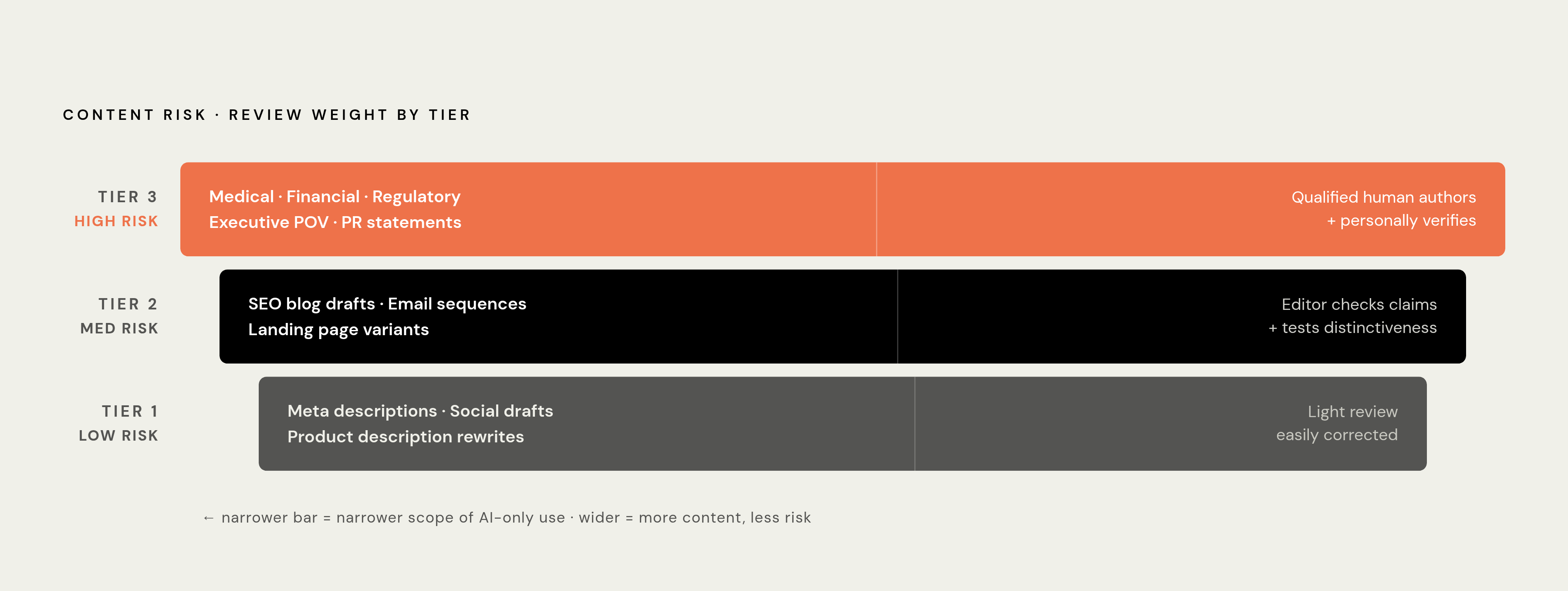
Tier 1 covers work done in large amounts with little risk, such as meta descriptions, social calendar drafts, and product description rewrites. These receive light review because errors have a low downside and are easily corrected. Light review is still a deliberate decision. It is not permission to skip looking at the output under deadline pressure.
Tier 2 includes SEO blog drafts, email sequences, and landing page variants. These need an editor who checks claims, adds real proof, and tests whether the content says something a competitor could not have said too. Tier 3 raises the responsibility further. Medical, financial, or regulatory claims, executive point-of-view content, and PR statements require a qualified human to author and personally verify the substance. Allocating attention by risk preserves the speed benefit of AI without treating every error as equally tolerable.
For that allocation to hold, the policy must be written down. It needs to specify the tiers, approval owners, and claims prohibited without particular sourcing, rather than leaving those decisions to deadline pressure. Brand voice needs a similarly reusable form. Tone rules, approved phrasing, forbidden words, reading-level targets, and claim boundaries become inputs every draft receives. Every AI suggestion must remain reviewable and reversible before publication.
Measurement closes the loop after that final gate. It shows whether approved content added to the archive gains search visibility, earns citations, engages readers, and contributes to leads. It also makes correction possible before weak output spreads further. A team can then assess whether a change to its process improved results or changed nothing, instead of treating the existence of a review policy as proof that the policy works.
What this means for teams producing content with AI
For a content or marketing lead ready to expand production, the practical starting point is an audit of the process already in use. The test is whether it holds up when output triples. Undefined review tiers, undocumented voice inputs, and missing citation measurement expose different weaknesses, so buying more drafting capacity does not address them. Teams that have normalized AI writing have completed one step toward expanding production.
The next decisions belong to team design. Before raising output, leads should assign approval responsibility by tier and make the required sourcing explicit. They should also make structured brand voice inputs mandatory in briefs, so contributors and channels do not develop separate versions of the brand through prompt drift. Ownership makes the policy usable under pressure. Without it, a rule that calls for review can be on paper while no one is clearly in charge of carrying it out.
Citation tracking then gives those owners more to go on than the publishing schedule. Letterstory, an AI content and visibility platform, offers one way to measure whether ChatGPT, Claude, Gemini, and Perplexity actually name and cite a brand. Citation results belong beside search, engagement, and conversion measures.
The lasting advantage is a body of content that future queries can reliably draw on. Each accurate, distinctive, retrievable piece can strengthen that body, while unchecked claims and generic output can weaken trust across it. That is the choice behind scaling production. AI becomes a compounding asset when the team can govern what it publishes and measure what it earns, and a compounding liability when generation outruns both.