End-to-End AI-Assisted Content Production Workflow
Systematic review gates and shared brand rules let AI multiply output without multiplying errors.
An end-to-end AI-assisted content production workflow is an architecture of stages, handoffs, and human review gates. Its value depends on how those parts connect. Quality and speed can coexist at volume when automation works within documented standards and human approval governs what reaches an audience.
In the meeting-room version of the debate, someone argues for “more AI” to increase output, while someone else argues for “less” to protect quality. Both positions treat AI as a volume dial. Turning it leaves the process as it is, with machines filling more or fewer slots. That is the category error. The consequential decision is whether to restructure the content supply chain or leave individual tools floating above it.
Meanwhile, demand is accelerating as brands face rising expectations for personalization and the need to reach human audiences and AI agents. Faster drafting does not resolve that mismatch. In a linear process, drafts can simply arrive sooner at the same bottlenecks.
AI can now produce usable text quickly. Brand identity, product accuracy, and operational control must stay consistent from the first brief until the content is published. Those are systems requirements.
The case for end-to-end AI workflows, and the objection that almost defeats it
A governed pipeline connects strategy, briefing, generation, review, optimization, and publishing so that each stage inherits the decisions made before it. Adobe’s report describes generative AI becoming integral to production, with early adopters adding agentic AI to connect siloed processes. The distinction is between acceleration and orchestration. Generation speeds individual tasks, while orchestration coordinates routing, approvals, scheduling, and asset reuse. Shared memory, persistent brand rules, and reusable content structures can support more output without proportional headcount growth.
Yet those connections also enlarge the error surface. A mistaken claim can propagate across campaign touchpoints before anyone catches it. Language models produce plausible language and can fill gaps with inaccurate, outdated, or fabricated information. Without clear rules for voice, factual errors can also come in different registers, with one asset sounding warm and another robotic. The same scale that makes the pipeline attractive can make its failures catastrophic.
Gannett’s AI content episode illustrates that exposure directly. Errors and tone problems became public before they were caught, reversing the order that governance requires. People criticized McDonald’s both for using AI and for content they found creepy and inauthentic. Bumble’s backlash came from a human-made anti-celibacy campaign that people called tone-deaf and at odds with its women-empowerment values. That distinction is essential because human authorship alone does not establish brand judgment.
The IAB’s research documents that over 70% of marketers have encountered an AI-related incident, including hallucination, bias, or off-brand content. Yet well under half plan to spend more on AI governance or brand integrity oversight. Exposure is outpacing the planned response to it. An architecture that multiplies output without strengthening approval can therefore magnify weaknesses.
Wayfair used AI to enrich product-attribute data across millions of legacy listings and emphasized humans in the loop as a proactive safeguard against hallucinations. Auditing should happen before changes reach customers. In an AI-assisted system, humans retain ownership of strategy, facts, and final approval while AI accelerates research, structure, and drafting.
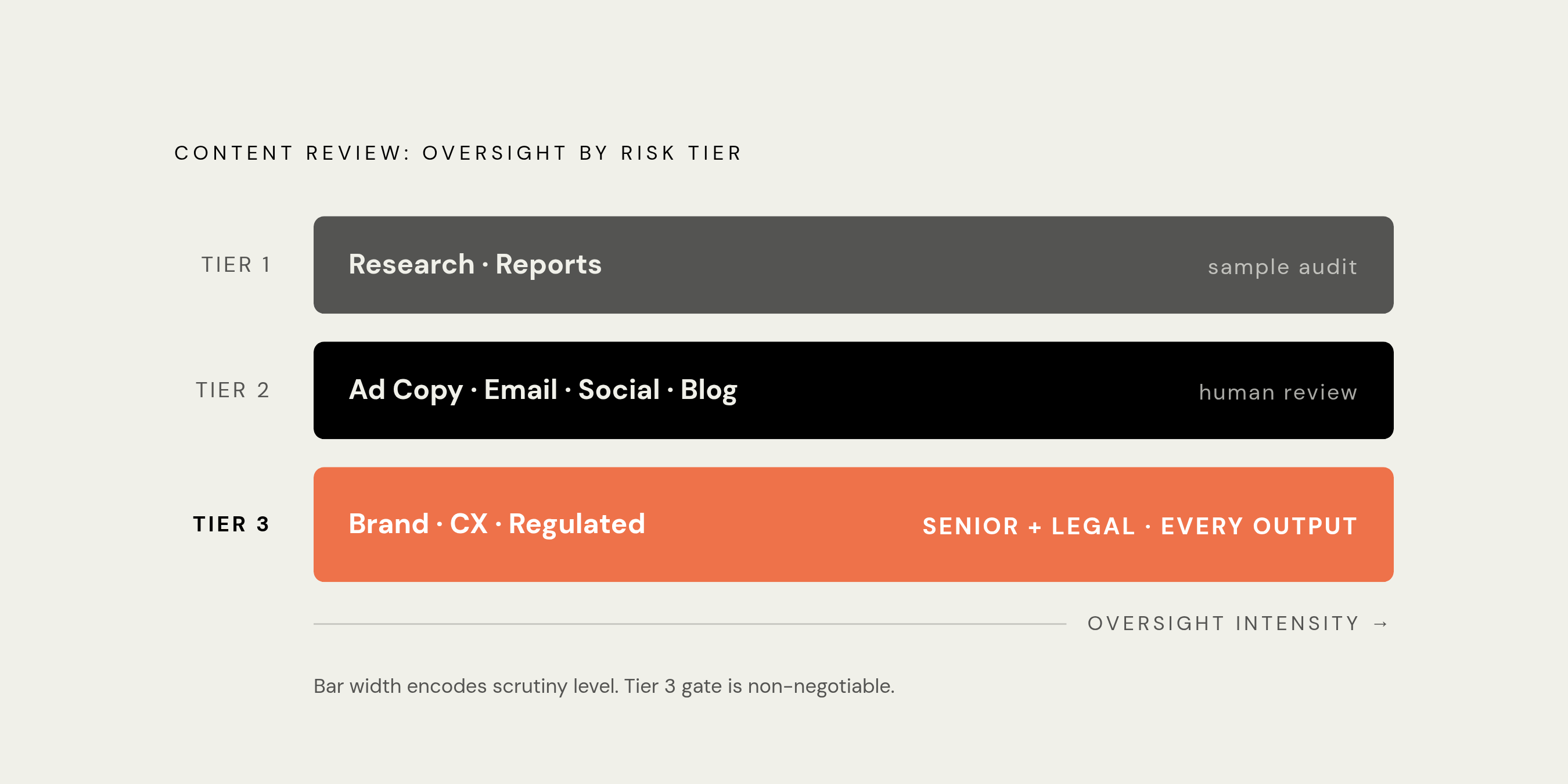
That ownership needs a risk-based allocation of attention. Tier 1 content, including competitive research and internal reports, gets sample checks as part of a regular audit cycle. Tier 2 content, including ad copy drafts, email variations, social posts, and blog outlines, requires human review before publication. Tier 3 content, including brand campaigns, customer service responses, and regulated content, requires senior review plus legal or compliance sign-off on every output.
Retrieval-augmented generation, or RAG, supports those gates by grounding responses in trusted product documentation, policy libraries, and approved claims. Grounding does not replace the review process. Editors can also sample outputs against defined voice and quality criteria, then feed recurring weaknesses back into prompts, examples, and guardrails. Additional scrutiny belongs with sensitive interactions, high-value audiences, low-confidence outputs, and departures from established style. Positioned correctly, review gates are a speed feature because they prevent downstream rework and public failures.
What an AI-assisted production pipeline actually changes for brand content
Knowledge held in a senior author’s head must become structured, reusable data to reliably guide every generated asset. An 80-page PDF of color codes, typography, and personality adjectives cannot actively stop a model from inventing product features or adopting a generic, hyper-polished cadence. AI exposes the gap between a brand’s identity and its documentation.
To close that gap, teams need voice pillars with clear examples, a message map of value propositions and proof points, and approved answers to common objections. The system also needs prohibited phrases, risky claims, regulated terms, stylistic examples, and explicit claim boundaries. This is not solely a writing exercise. Brand, legal, and content operations must agree on what the organization is permitted to say. Without that agreement, generic inputs produce the familiar committee of polite robots.
The documentation discipline has a less obvious consequence for discovery. ChatGPT, Claude, Gemini, and Perplexity are becoming a primary front door to information, and citation in their answers is a different objective from ranking on Google. Success in one does not guarantee the other. Clear headings, FAQs, explicit sourcing, and bounded claims support retrieval and attribution, while fact-verified content reduces the risk associated with unsupported assertions. A consistent body of content on owned properties gives answer engines a stable source to cite.
The production architecture therefore becomes infrastructure for AI visibility. Teams need to track whether answer engines name and cite the brand as well as whether its pages rank. Without that visibility, they cannot know which pipeline decisions need to change.
Strategy starts with AI scanning competitor content, topic gaps, trends, and keyword clusters, followed by human filtering against business goals and genuine expertise. A topic advances only when the brand can offer something true and useful that serves an audience need. That approved topic becomes the input to briefing. AI develops the audience, keyword strategy, outline, and internal linking opportunities, while a human defines the hook, rearranges the argument, adds proprietary substance, and removes filler.
The brief is the steering wheel for production. It should be specific enough to produce a draft that is 70% usable before the work advances. A weak brief can consume more time in revision than generation saves. Within an approved brief, AI drafts against the brand voice system and trusted enterprise knowledge. Humans judge how the draft fits the strategy, add insight only the business has, check factual claims, and send it for formal review.
At the quality gate, AI performs grammar, plagiarism, voice consistency, and SEO compliance checks, while humans apply the required risk-tier approval. The handoff depends on documented standards. One option is Letterstory’s multi-stage editing pipeline, where human reviewers accept or reject every AI suggestion before publication. It brings factual claims, brand voice, and tone consistency to reviewers’ attention so they can check them without having to read every draft cold.
Once approved, the content moves into optimization. AI generates title tag variations, meta descriptions, internal link recommendations, image alt text, and semantic coverage analysis. Human confirmation that these elements accurately represent the content and respect claim boundaries permits the publishing handoff. AI then handles CMS upload, scheduling, and distribution, while humans monitor performance, including answer-engine citations. Those findings go back into the brief and prompt templates so shared evidence helps improve the pipeline and each person can learn from what others have found.