GEO vs SEO Content Objectives and How They Differ
SEO targets ranked clicks while GEO aims for citations within AI answers.
GEO and SEO use many of the same inputs, but they have different goals for content. SEO pursues a ranked position a user can click, while GEO pursues inclusion in an answer the user may never leave. That difference changes what teams write and how they measure it, so AI visibility platforms such as Letterstory have a role beyond the usual SEO dashboard.
Most content teams arrive at GEO after years of doing SEO, so the request can feel like a renaming of existing work. Authoritative sourcing, structured content, and topical depth are not new demands for experienced practitioners. Strong SEO already calls for pages that answer questions clearly and demonstrate expertise. Much of the work genuinely overlaps.
That overlap begins with crawlability and indexability, which make content available for discovery. Clear headings give that content an order, while structured definitions and direct answers make it easier to use. Both favor content that shows expertise over thin content, and the E-E-A-T signals tied to search quality also help retrieval systems judge what to trust. A passage suited to a search snippet can also supply material for a synthesized answer.
The mistake begins when teams treat those foundations as evidence of a shared objective. A checklist describes the inputs to a process, but it does not establish what counts as success. Practitioners can be right that many GEO requirements are familiar and still need a different strategy for evaluating their results.
How their content objectives actually diverge
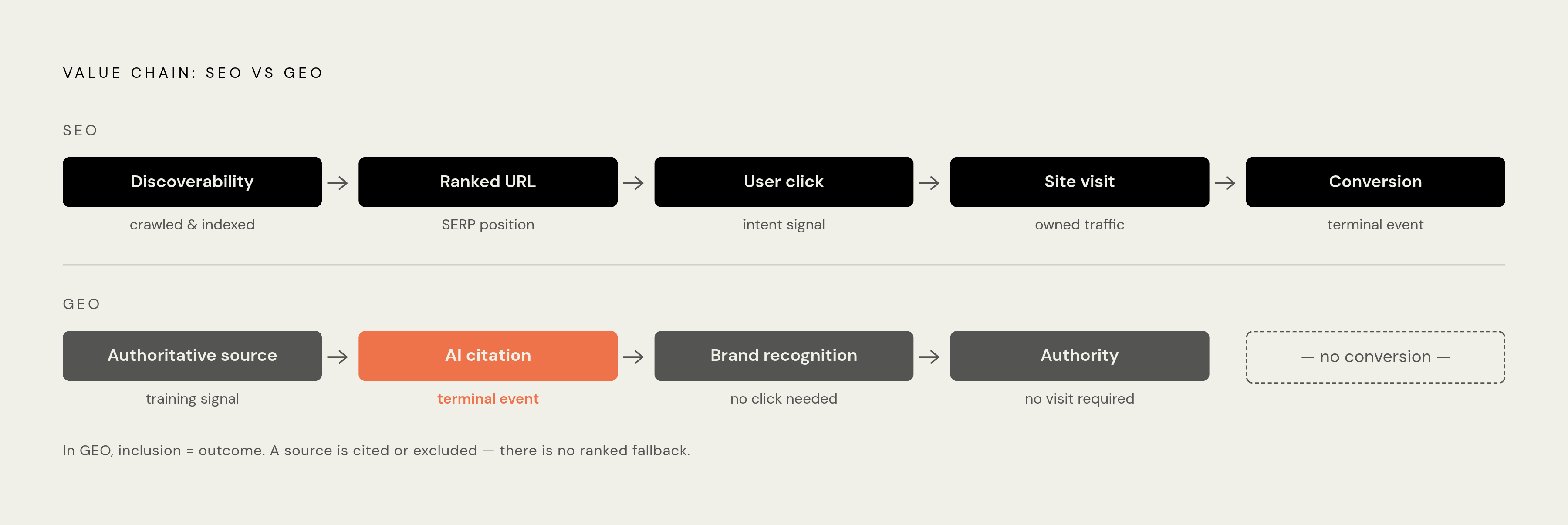
SEO follows a chain from discoverability to a ranked result that a user can click. Its unit of competition is the URL, placed against other URLs on a results page. The page earns an opportunity to receive a visit, after which the site can serve the reader and support conversion. Content quality, keyword relevance, and link structure contribute to that opportunity.
GEO follows a different chain, from authoritative source to inclusion in an AI response, then to brand recognition and authority. Generative engines synthesize information from multiple sources rather than primarily directing users to external websites. The answer can satisfy the request without a visit to any source. Consequently, citation is not merely an intermediate step toward traffic. It can be the terminal event through which the content creates visibility.
That change alters what the engine needs from the page. Search optimization works at the page-and-keyword level, while GEO also depends on entity recognition, brand mentions, topical authority, and structured clarity. AI systems assess how concepts relate to each other and use that material to answer complex conversational queries. The objective is therefore not only to make a page discoverable. It is to influence how a system cites, summarizes, and recommends the brand within its answer.
The distinction also explains why search performance cannot stand in for AI visibility. The overlap between URLs cited by LLMs and Google's top results is strikingly small, so a strong ranking does not reliably predict a citation, or vice versa. Shared quality signals do not make the two sets of selected sources interchangeable. Letterstory tracks whether content earns citations across ChatGPT, Claude, Gemini, and Perplexity.
Time further separates the objectives. SEO rankings can last for months or years, while AI citations fade faster and rely heavily on fairly recent content. Citation authority therefore needs ongoing work to keep it, even after it has been built up. Visibility also differs sharply across engines, with the same brand frequently cited on one and nearly absent from another. A single measure of general authority cannot describe those platform-specific outcomes.
A URL in search has a position among other results and can move up the ranking curve. For a particular AI answer, a source is either included or excluded. There is no position two that compensates for an absent citation.
What that difference means for how you write and measure content
A brand can earn a citation in a ChatGPT answer, receive no click, and record zero impressions in Google Search Console. OpenAI provides no such reporting there, leaving a real visibility event outside the usual search dashboard. AI Overviews differ because Google Search Console's dedicated Generative AI features report, launched June 3, 2026, records impressions, though click data remains unavailable. The reporting gap therefore varies by surface across AI discovery. A traffic report alone cannot show whether content has succeeded at GEO.
Because that success happens inside an answer, the writing must work when extracted, even without a visit. A thorough SEO page can build its argument across sections and use internal links to lead readers to pages that support it. GEO also needs self-contained paragraphs that still make sense when taken out of the text around them. Definitions and short explanations should answer the question completely enough to be extracted and attributed. Depth still matters, and the content also needs a passage that can be used on its own.
An authoritative tone is useful, but precise evidence gives a retrieval system something concrete to cite. The original GEO research paper from Princeton, IIT Delhi, Allen Institute for AI, ACM KDD 2024 found that adding statistics measurably improves AI citation rates.
Placement matters for the same reason. A large share of LLM citations comes from the opening portion of content, so a GEO-oriented lead should present its most citable claim. Teams also test finished prose through multiple AI models, varying sentence-level phrasing while preserving facts and structure to assess extraction and synthesis. This rewriting step serves human readability and retrieval together. It adds to the technical foundation of SEO rather than replacing crawlability, indexability, or relevant keywords.
Share of Model, or SoM, measures the percentage of AI-generated responses that include a brand across a set of queries chosen for that category. Supporting measures include brand mention share, topical visibility, prompt-level visibility, domain influence and citation share, and sentiment distribution. These describe presence and treatment within responses, whereas SEO reports describe URL appearances, queries, clicks, and conversions.
The practical measurement approaches serve different purposes. An AI visibility platform measures mentions and citations, conventional SEO reporting retains the ranking and conversion view, and tagging LLM referrers captures sessions that reach the site. Referral tracking gives teams a place to start, but it misses answers that bring no visit. Monitoring must also distinguish ChatGPT, Claude, Gemini, and Perplexity. Because a model update can replace a large share of cited domains overnight, teams need to keep monitoring citations between ranking audits.
Teams following this model publish and measure their content on an ongoing basis. For teams using that model, Letterstory has a content engine, monitors citations across those engines, and reports on Share of Model. Its relevance is the connection between published content and measured AI presence, rather than an assumption that one optimized page will keep earning citations. SEO remains necessary, but search-only reporting leaves part of discovery unobserved. Teams can close that gap by defining their query set, publishing real, retrievable content on a cadence, and instrumenting brand mentions and citations separately for each engine.