Content Strategy Frameworks for B2B SaaS Rebrand Launches
Most B2B SaaS rebrands fail because they skip positioning work before the design launches.
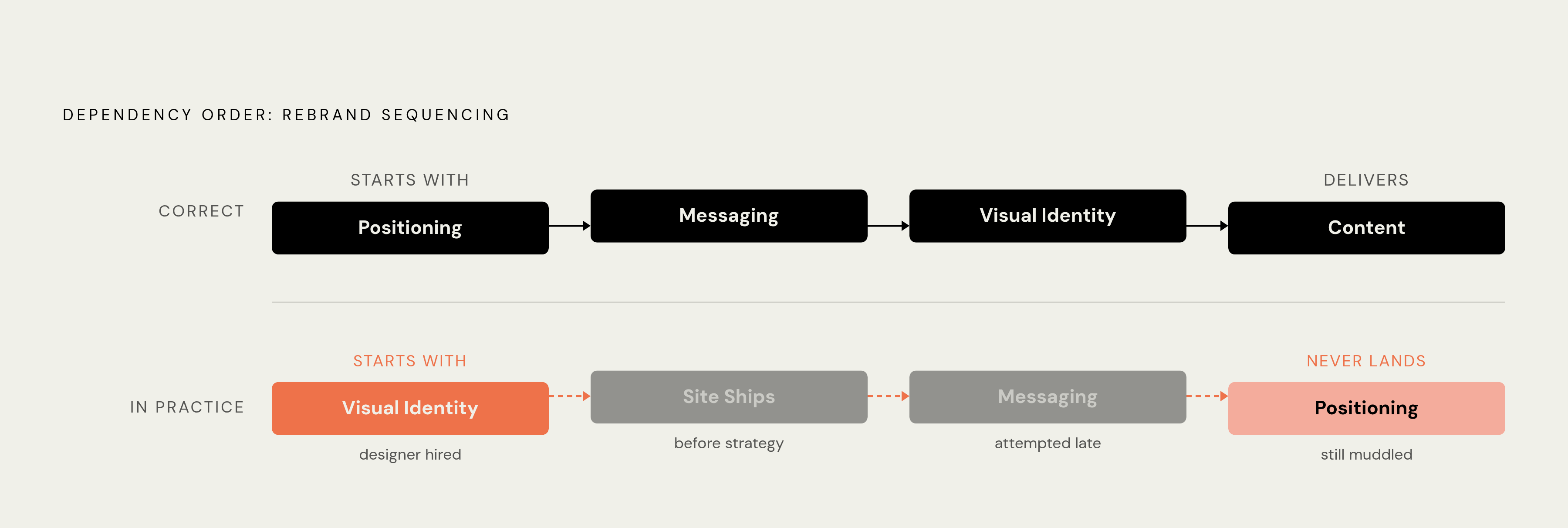
Most B2B SaaS rebrands treat brand as a coat of paint, applied after the real strategic work is already finished, when it should be the foundation content stands on. The sequence that actually produces results runs positioning first, messaging second, visual identity third, and content expression last, as the established B2B branding playbook lays it out. Most companies run the opposite order in practice: a designer gets hired, colors get chosen, a new site ships, and only then does anyone try to work out what the company is supposed to say on it. Content strategy falls into the gap between those two sequences. Content strategy appears after the logo is already locked, handled as a production task rather than something that shapes the company's direction.
The pattern repeats with enough regularity to count as a template. A SaaS company closes a Series A round. The newly hired VP of Marketing's first move is a rebrand: new logo, new color palette, new website. Four months later, the positioning is still muddled, a prospect could paste the messaging onto a competitor's homepage, and pipeline hasn't moved. The new site often looks like it belongs to a company several times its size, all polish and no specificity, and it never tells a buyer why this particular company should care about this particular product. When the board asks what happened, the honest answer is that brand got treated as a design exercise when it needed strategic decisions.
The root cause sits inside the building before it ever reaches a buyer. Asking the CEO, the head of sales, the head of marketing, and a senior customer success manager to describe the product in one sentence, separately, without comparing notes, produces answers that rarely match. That mismatch is the real problem: a team that describes its own product differently depending on who's talking will produce content that carries the same inconsistency into every buyer interaction, email, call, or page they encounter. The rebrand doesn't fix that. A new color palette does nothing to unify four conflicting internal narratives.
The content team ends up getting blamed for a failure it didn't cause. Content is usually handed a messaging brief only after positioning decisions have already been locked, or handed nothing at all and expected to reverse-engineer the new story from a design system. The biggest mistake B2B SaaS companies make with content marketing is sequencing: teams push out more blog posts, more case studies, more social content before anyone has sharpened the underlying narrative those assets are supposed to carry. That failure mode predates most rebrands. Only a minority of SaaS marketing teams rate their own content strategy as highly effective, and close to half don't measure content ROI. If a rebrand launches without a content framework, it doesn't create that dysfunction. It inherits it, at the exact moment the company most needs clarity, and makes it worse.
Timing compounds the damage in both directions. A four-week rebrand timeline skips the strategy phase outright, and there isn't enough runway to do the positioning work the content depends on. But a timeline that stretches too long invites a different failure: internal politics have more time to water down the strategy, and by launch the positioning has been negotiated into something inoffensive and forgettable. Content strategy can't be compressed into the final two weeks of a rebrand without losing the one thing it exists to deliver, a consistent, differentiated story buyers can actually follow and repeat back.
Recent rebrand failures share a structural flaw that goes beyond weak execution: they removed the differentiation that gave the brand something to say. Jaguar's November 2024 relaunch abandoned its luxury heritage to present as an EV-first lifestyle brand: it deleted its social history and replaced decades of British heritage imagery with abstract fashion visuals. The failure wasn't the visual shift itself. Jaguar didn't redefine what it stood against, it erased the contrast that made its prestige legible, and luxury buyers who rely on exclusivity to signal status have little use for a brand that reads as anonymous. Cracker Barrel's August 2025 rebrand replaced its "Old Timer" logo with a generic wordmark; the stock dropped and the logo was restored within days. Gap's 2010 rebrand is the only comparable reversal, and it lasted six days before the company brought the old logo back. Cracker Barrel's old logo had fought against soulless, corporate dining chains. Removing it made the brand interchangeable with everything it used to stand apart from. Southwest Airlines, in March 2025, abandoned free bags, open seating, and the cultural edge it had spent decades defending, defecting to the very category norms it had built its identity in opposition to. Customer loyalty eroded, and content had nothing distinctive left to write about.
Amazon's May 2025 identity overhaul shows what the alternative looks like. After decades of fragmented sub-brands, Amazon unified its visual system with new typefaces, a deeper orange, and a sharpened version of its smile mark, rolled out across packaging, uniforms, and digital properties in numerous markets. The smile wasn't replaced, it was deepened. The arrow wasn't abandoned, it was sharpened. The brand's core tension stayed intact. Every one of these cases confirms the same mechanism: great brands fight against something specific, the way Apple fought conformity, Nike fought excuses, and Tesla fought fossil fuels, and a rebrand that smooths away that opposition in pursuit of neutrality removes the reason anyone had to pay attention.
That erosion now carries a second, newer cost. AI answer engines need to answer three questions with confidence before they'll surface a brand at all: who you are, what you do, and who you serve. When a brand has a strong, consistent entity, it gets named clearly in response to buyer queries. A brand with a fuzzy one gets a hedged, vague description, or gets skipped. Entity strength functions as the foundational signal for AI-driven discovery, and a rebrand that ships a new visual identity before its messaging framework is settled degrades that signal at the exact moment the entity is most exposed. When brands go through radical or incoherent rebrands, they can see significant monthly decay in AI mentions, driven by lost entity coherence. Visibility also varies sharply by platform: citation volume for the same brand can differ enormously between Grok and Claude, and a brand well-cited on Perplexity can be nearly invisible on Gemini. A rebrand with no content framework has no systematic way to manage that variation across engines. Cracker Barrel and Jaguar illustrate what this looks like structurally: when Cracker Barrel dropped its logo, AI systems reclassified the brand as interchangeable with competitors, and when Jaguar erased its heritage, AI systems lost the anchor they needed to describe the brand distinctly. Amazon's refresh avoided both outcomes because its core tension stayed intact, and its AI visibility was unaffected.
The case for building content frameworks before the rebrand goes live
Pre-launch framework work is the mechanism that heads off those same failures before launch. When you write strategy down, review it on a set cadence, and tie it to specific pipeline goals, that is what separates high-performing content programs from expensive experiments. The operative word is documented. A framework has to specify audience definition, measurement approach, and distribution channels before a single piece of content gets produced under the new brand, and its content pillars need to map to buyer need rather than product features: the problems the product solves, the industries or personas it serves, the strategic priorities buyers actually weigh, not a list of capabilities repackaged as themes.
You need to run three audits in parallel before design work starts, not after it. The internal alignment audit asks the CEO, the head of sales, the head of marketing, and a senior customer success manager to answer, in writing and without conferring, what the product does and who it's for in one sentence each. More than one distinct answer means the brand has an internal alignment problem before it has an external one. The content-to-pipeline attribution audit asks which existing content is actually contributing to enterprise pipeline; if nobody knows, you have to build tracking infrastructure before you rebuild the content strategy, because you have no baseline to measure whether the rebrand changed anything. The messaging consistency audit checks whether the homepage, the sales deck, and the top five traffic pages tell the same story. If discrepancies survive to launch, they become the inconsistent entity signal that degrades AI citation later.
The positioning-to-messaging-to-identity-to-expression sequence is a dependency chain, not a stylistic preference. Positioning is the strategic foundation: who exactly the product is for, what category and angle it occupies, and why a buyer should choose it over a competitor. If a positioning statement could be pasted onto a competitor's site without anyone noticing, it isn't positioning. Messaging translates that positioning into language buyers actually read, built as a written hierarchy with a core value proposition, three to five message pillars each mapped to a buyer priority, and proof supporting each pillar, framed around outcomes the buyer cares about. Identity and visual expression come last. They make positioning visible; they don't substitute for it. Gong named the category "Revenue Intelligence" and owned it. Drift built "Conversational Marketing." Neither was a design decision. Both needed a content framework that could make the positioning legible to buyers at scale.
The work scales with company stage. At Series A, brand strategy matters most, because the company already has product-market fit and is scaling fast enough that every new hire, new customer, and new piece of content needs to communicate the same thing. At that point, you need to invest in real positioning, a complete messaging framework, and visual identity guidelines a growing team can actually follow. Brand is cheapest to build while the company is small, with fewer touchpoints to update and a smaller team to align, and most expensive to fix once it's large, when hundreds of pages, dozens of templates, and a sales team with years of inconsistent messaging all need correcting at once.
What a framework-first rebrand launch actually requires from your team
A rebrand that follows this sequence demands coordination most marketing teams aren't structured for by default: positioning owned at the leadership level, messaging built before a single landing page gets redesigned, and content pillars tested against the positioning statement. Each pillar should earn its place by advancing the positioning; if an asset can get published under a pillar without reinforcing what the brand is supposed to stand for, the pillar is too broad to do its job. Tone belongs inside that same pillar definition, not as a finishing touch. A developer tool earns trust with precise, jargon-light copy. A category creator needs to sound bold and willing to take a position. Funnel structure also needs rethinking for a rebrand launch specifically: comparison and conversion content should go first, ahead of top-of-funnel educational content, since the people most likely to notice a rebrand immediately are the ones already evaluating a purchase.
None of this is optional overhead layered onto a design refresh. It's the only way a rebrand changes how buyers find and understand a company, both in organic search and in the AI answer engines increasingly setting the shortlist before a buyer ever opens a search bar. Platforms built around this discipline anchor content production to a documented framework and track whether the new positioning actually lands in buyer discovery, AI answer engines included, so they don't just produce more content under a new coat of paint, Letterstory, for instance, measures whether ChatGPT, Claude, Gemini, and Perplexity actually name and cite the brand, not just whether it ranks. A rebrand that skips the framework and goes straight to execution hasn't saved time. It has postponed the real work to a point where undoing it costs far more than doing it correctly the first time would have.