Content Cadence Design for AI Retrieval Freshness
Map how fast each topic goes stale, then set refresh intervals to match.
Content cadence for AI retrieval freshness should follow how quickly a topic goes stale. Start by mapping topic decay, then use it to set refresh intervals. That gives fast-moving pages the work they need to keep their answers up to date, without spending as much time on evergreen pages whose answers have barely changed.
A standard editorial calendar starts with a production target, perhaps two posts per week or one per day. The team fills the queue and measures whether it hit the number. That approach fits a crawl-index-rank world, where more pages give an engine more to index and cover more keywords. AI answers introduce a different selection step. An engine synthesizes an answer and chooses citations at query time, so having a page available does not mean it will use it.
Freshness enters through that selection process. RAG-based systems such as Perplexity and Bing Copilot pull content from the live web and feed it into a generation layer. Google AI Overviews draw from its index while weighing which sources appear reliable and timely for the query. The recency bar depends on the question. A product comparison accurate eighteen months ago may now mislead, while a foundational explanation may still answer the query well.
Freshness thus acts as a gate to whether a page can be cited, going beyond the boost a page gets for being new. Systems can exclude stale material or contradict it within the same answer. Signals include when a page was published or changed, whether it agrees with authoritative sources updated recently, and whether its entities and statistics match newer information. A recent timestamp is only one signal. The underlying claims must also fit the current state of the topic.
The urgency varies across engines, which complicates any single publishing target. Perplexity leans strongly toward freshness on competitive, time-sensitive topics, while Claude and Gemini give structured depth and expertise signals more weight than raw recency alone. Meanwhile, the share of searches that showed AI Overviews roughly doubled between early 2025 and early 2026. Calendar design has not kept pace with that change. Calendar design therefore needs to account for how quickly each topic goes stale and when it needs attention again.
Why cadence should follow how quickly each topic goes stale, and the strongest objection to that
Google's research distinguishes two ways content becomes stale, namely supersession and relevance decay. Supersession happens when something new abruptly displaces what came before, such as a regulation, price or model release. Relevance decay is slower, as the way a system judges content falls behind a topic that changes bit by bit. These mechanisms need different responses from a calendar. Supersession calls for an update when the event happens, while gradual decay lends itself to a predictable review cycle.
Pricing, competitive comparisons and annual roundups depend on facts that can change quickly. Stable how-to guides and foundational concepts can retain their usefulness much longer. Their clocks do not run at the same speed. A schedule based on topic half-life allows time for work on each page based on how long its answer holds up.
Seer Interactive's July 2026 study found that most pages cited by AI engines had been updated within the past year. Among the subset where both publication and update dates were readable, only 42% had been published within that year. The finding supports counting maintenance as publishing work, though it does not show that changing a date alone leads to more citations.
But can a team maintain a large library this way without sacrificing quality? That is the strongest objection to decay-based scheduling. Refreshing everything on a 7–14 day cycle is not feasible, and AI-assisted production does not remove the need for editorial review. Review capacity is often the binding constraint. A schedule that ignores it may lead to more drafts while leaving the hard work of checking claims and making answers better undone.
The response to that constraint is triage. A team in that position should save short refresh intervals for pages whose facts or competing sources change fastest. Stable pages can go longer between reviews, with work done sooner when a change affects the answer. A few authoritative pages that are kept up to date can work better for retrieval than shallow posts written to meet a quota, because the retrieved passage must answer the query clearly.
To place pages in those tiers, the audit needs to look at both the topic and its retrieval environment. Does the page rely on a product version, a regulatory body, a price point, an annual report or current-year search intent? Those are signals of potentially fast decay. A methodology or concept that stays the same points to a slower cycle. But the underlying facts are only half the diagnosis, because refreshed competing pages and new authoritative sources can also change which material an engine finds useful.
The first audit gives a working estimate that can change over time. Citation monitoring then tests whether the assigned interval fits the page's behavior. AirOps's October 2026 tracking across roughly 3.5 billion citations found that the share of citations going to owned brand and product pages fell from mid-2025 to mid-2026 as creator and social sources gained ground. That shift makes neglect less neutral than it appears. A drop in a page's citations calls for investigating freshness and reconsidering its tier, with age as a possible cause of the loss.
What this means for planning a publishing calendar
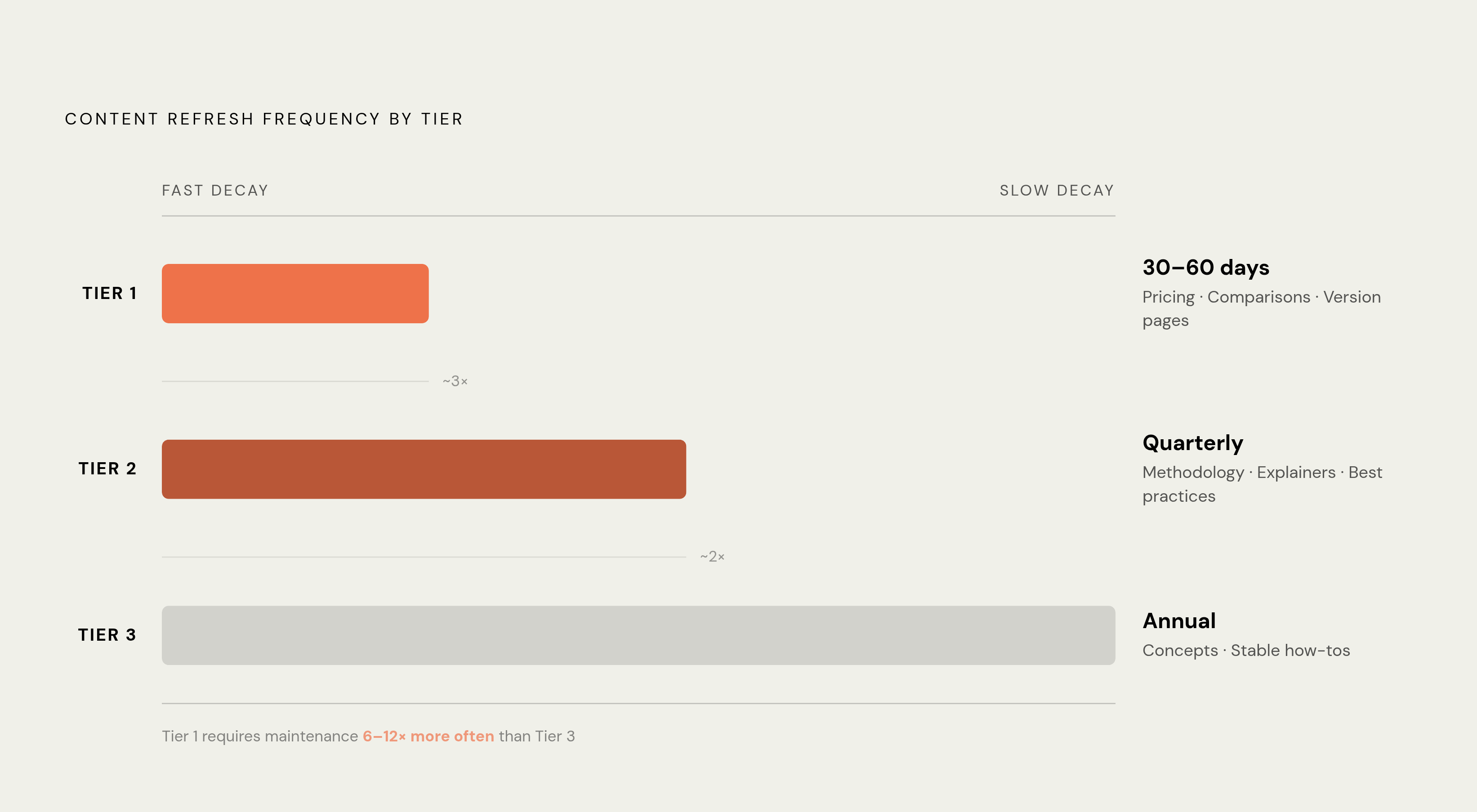
The calendar then sets aside time to keep fast-decay pages up to date after they are published. Tier 1 includes pricing, competitive comparisons, product version pages and annual “best of” roundups, with refreshes every 30–60 days at minimum. Supersession can call for work before that slot arrives. A standing watcher that flags a relevant event and queues a draft makes reactive freshness part of the workflow. An editor still needs to review that draft before it becomes an update.
Tier 2 gives methodology posts, category explainers and best-practices content a quarterly refresh, with earlier work when a major industry shift or new study changes the answer. Tier 3 gives foundational concepts and stable how-to pages an annual refresh or an update on trigger. Those triggers include a loss of citations, a topic change that affects the answer or a competing page that has changed a great deal. These are starting intervals. A methodology page whose answer stays the same may need less work than another page in the same format.
A team can add pages for sub-queries its library does not yet answer, at a pace that permits genuine depth. Consistency is still useful under this model. Steady coverage over months shows ongoing topical commitment, whereas a burst followed by silence leaves maintenance unresolved. Original research and proprietary data add another benefit by making the brand a source that other articles can cite.
The schedule must also make time to measure results, because organic rankings do not reliably show whether an AI engine uses a refreshed page. Many AI Overview citations come from outside the top organic results. The relevant measure is citation frequency across the engines used by the audience, tracked by prompt, topic cluster and time. Letterstory, an AI content and visibility platform, is one option for measuring whether ChatGPT, Claude, Gemini and Perplexity name a brand and cite its pages over time. It shows when citations drop so teams can check whether a page has slipped outside the freshness gate.
The schedule also extends beyond the owned site. AirOps's August 2026 snapshot found that Google AI Overviews drew roughly one in every 9–10 citations from creator surfaces. The calendar needs to account for the platforms engines draw from for the relevant topic, rather than assuming every useful source lives on the brand's domain.