How to Build Content That Targets Specific Accounts, Not Just Personas
Account-based content requires knowing your buying committee before writing, not afterward.
Persona-based content and account-targeted content solve different problems, and treating them as variations on the same method is where most ABM programs go wrong. Classic persona logic markets to an archetype and waits for the right individual to self-select into a funnel; it works when the identity of the buyer is the unknown variable. Account-based marketing starts from the opposite condition: the accounts are already chosen. The question that matters is who the six to ten people inside one named company are, and what will move each of them toward a shared yes.
Traditional personas describe the ideal customer as a single person, a composite sketch built for repeatability across an unknown audience. That design assumption collapses inside a real ABM deal, where the buying group includes a VP of Marketing, an IT Manager, a CFO, and an end-user champion, all inside the same account, all looking at the same product, and all having a completely different conversation about it. A persona built for one of those four will misfire for the other three, and narrowing that persona, the instinctive fix, only produces a smaller version of the same wrong instrument [1][2][3]. Resolution was never the problem. It was the premise that one archetype could stand in for a committee.
That premise carries a measurable cost. Gartner's survey of 632 B2B buyers found that most buyer teams show unhealthy conflict during the decision process, and that the groups who manage to reach consensus rate the resulting deal as substantially higher quality. Content built for the buying group as a whole lifts consensus meaningfully. Content built for one person inside that group has a significant negative effect on it. Ads, emails, and SDR scripts that all speak to the champion's feature list leave finance and legal out of the conversation entirely, and finance and legal respond by becoming blockers instead of buyers.
Most ABM programs do not actually escape persona logic, they just rename it. Wrapping an account name around the same role archetypes a team already had, without rebuilding the messaging unit around the buying committee, is still writing to one decision-maker and hoping the rest of the account finds its own way to a yes. That hope is not a targeting strategy, it is persona logic with a company logo stapled on top. What an ABM program needs to answer is what it takes to build content that moves one specific named account, as a group, toward one decision.
Account-specific content requires different inputs than persona work, not just narrower ones
The operating principle that separates account-targeted content from persona content is sequencing: the account list has to exist before the content idea does. Persona-based planning starts with a content calendar and works forward toward whoever happens to show up. Account-targeted planning starts with a ranked list of named companies and a defined window, weeks to a few months, during which those accounts are the priority. Directive's 2026 ABM strategy guide states this directly: a modern ideal customer profile is built from fit, intent, and timing data, and the target account list should be reviewed and refreshed monthly. If a given piece of content cannot be tied to a named deal or a specific account's decision, it belongs in a different program.
Four categories of input mark the difference in practice.
Intent data has to be tracked by role, not by segment. Knowing an account is in-market is not the same as knowing which part of its buying committee is active right now; an economic buyer consuming ROI content is at a different stage than an end user reading implementation docs. Directive treats intent hit rate, the share of the target account list showing above-threshold intent in a recent rolling window, as a primary input to account prioritization.
The account's own language and context have to be researched directly, not personalized with a first-name token. Effective account content names the account's actual stack, its stated business priorities, and the specific cost of its status quo. Factors.ai describes how the device-intelligence company Fingerprint goes beyond job titles to map who is likely to shape a decision, who has to approve it, who will evaluate the product, and who will be involved in implementation. That research is the brief itself, not a persona template filled in with a company name.
Buying-committee coverage has to function as a design constraint, not an afterthought. A CFO inside a target account wants long-term cost savings and compliance assurance. A CTO at the same company wants integration depth and risk reduction. A VP of Operations wants workflow fit. These are not the same asset with three different subject lines; Directive's account plan framework assigns each role its own value proposition, economic buyers get ROI and cost-savings framing, technical buyers get integrations, security, and risk reduction, user champions get usability and workflow efficiency, and tracks coverage rate, engaged contacts divided by required roles per tier, as its own metric.
Sequencing has to be triggered by account signal, not by a publishing calendar. Content activates when pricing-page visits, demo replays, or documentation usage fire at the account level, and it gets used directly in sales conversations instead of being routed through a generic nurture queue. Producing content without sales involvement in that loop produces assets sales will not use, because they do not match the conversation actually happening. That is a planning failure, not a content-quality one.
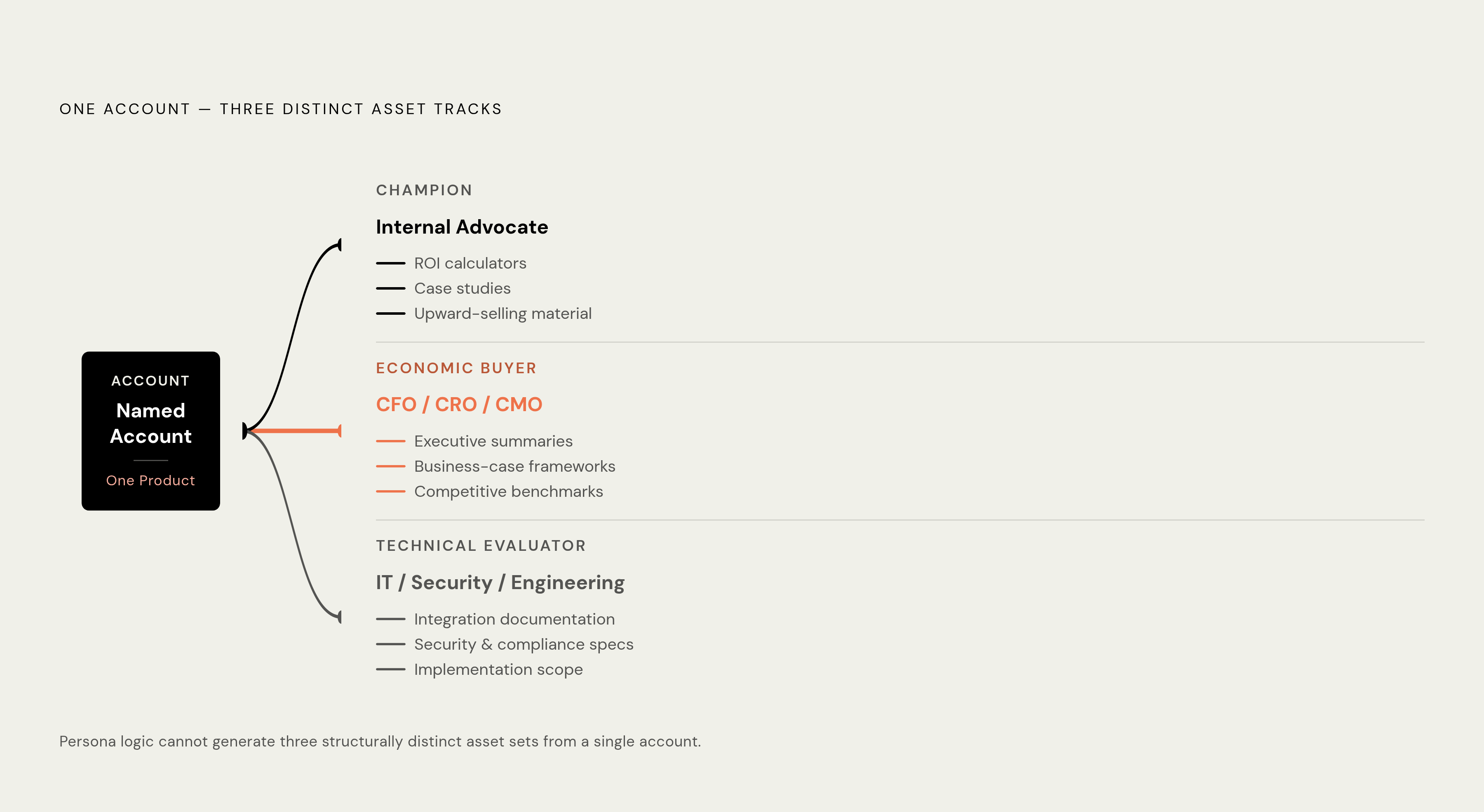
Once the buying committee becomes the unit of design, the brief for any given asset specifies role before it specifies topic, and the formats that follow are different by necessity. A champion, the internal advocate pushing the deal forward, needs ROI calculators, case studies, product walk-throughs, and material that helps make the case upward inside their own org. An economic buyer, the CFO, CRO, or CMO who holds the actual yes-or-no, needs executive summaries, business-case frameworks, competitive benchmarks, and ROI data, and is rarely interested in product detail below that level. A technical evaluator in IT, security, or engineering needs integration documentation, security and compliance specs, and implementation scope, because that stakeholder's stake in the deal is whether the product breaks anything, not whether it is a good product in the abstract. Same account, same product, three distinct assets, and that variation is what a persona built around one archetype cannot generate.
Distribution follows the same logic. Foundational content belongs in early awareness, industry-tailored content belongs in the moment a specific account enters active consideration, and account-specific content gets held for the late-stage moments where it can actually tip a decision. Content activated by a live signal, a demo replay, a return to the pricing page, a documentation session, reaches whichever committee member is actually moving at that moment, instead of whoever happens to be sitting on a nurture list.
The scale objection has to be taken on directly: full personalization for every named account is not economically sustainable, and that is true. But persona-based content run at volume is not the answer either; it delivers industry-level material that performs adequately for a narrow band of top accounts while offering the appearance of personalization without the substance. Neither approach works applied uniformly across a full account list, and the resolution is not to pick a side but to match production investment to account tier, enforced with discipline.
Three tiers do that work in practice. Tier 1 is the 1:1 strategic tier: ten to fifty named logos get custom landing pages built around the account's name and specific business context, executive briefing documents for named stakeholders, and custom analysis of the account's public market position; effort is high, and the tier is reserved for accounts where a single win pays for the whole program. Tier 2, 1:few, groups a defined set of accounts by industry, tech stack, or trigger event such as a funding round, a hiring surge, or a compliance deadline, and adapts roughly a fifth to two-fifths of a base asset into industry-specific case studies and comparison content, economics that work because the accounts in the group share real context. Tier 3, 1:many, covers hundreds of accounts through ads and automated sequences; it still requires a named list, but it does not require a custom microsite per logo, and it is more accurately described as ABM-flavored demand generation than account-specific content. A useful check on all three: if sales cannot name the accounts in a standup, the program is not in Tier 1, it is in Tier 1:many with extra slides.
The constraint on Tier 1 production is no longer headcount by itself, it is brief quality and review speed. A structured brief, one that specifies account context, asset type, audience role, and core argument, is enough input for an AI drafting system to produce a usable first version, which a human team then reviews, edits, and approves. That shift moves the bottleneck from writing to reviewing. A multi-stage AI pipeline with human review, the kind Letterstory runs, is built for exactly that shift: AI absorbs the personalization and signal-processing work that used to require human bandwidth, so a small team can hold one-to-one relevance across entire buying groups at close to one-to-many cost. Human oversight on Tier 1 accounts is not optional polish, it carries the weight of the program, because the accounts where a small miss costs a deal are the ones that need a human judgment call, while the long tail can absorb a cheaper miss. Directive's 2026 guide identifies a named account executive paired with custom research and custom pages as the Tier 1 standard, and that pairing now includes an AI drafting layer, not as a replacement for the AE's judgment but as the mechanism that makes custom-page production viable at that scale.
What account-targeted content changes about how you plan and measure
Account-targeted planning starts with a time-bound account list and works backward to content; persona-based planning starts with content ideas and works forward toward a hoped-for audience that may or may not materialize. Making that reversal operational means setting a thirty-to-ninety-day ABM account window, tying every asset to a specific account or cluster inside it, and cutting any piece that cannot be named to the deal it is meant to influence. That is a planning discipline, not a content-quality standard, and it is the discipline most programs skip.
ABM content planning that begins with a quarterly content calendar and a list of "high-value industries" produces content designed for hypothetical accounts rather than named ones, and that failure mode becomes visible once sales tries to use the content on a real deal. That is persona logic operating under an ABM label, and no amount of account-based terminology changes what it actually is. The accounts have to come first, the committee has to come second, and the content has to be built for both, in that order, or the program is running the old method with a new name on it.